Translate retail fields for shoppers
Map SmartVendor SKUs, UPCs, parent items, categories, descriptions, images, price levels, sale dates, and matrices into a web catalog people can understand and search engines can crawl.


Acceo SmartVendor + CMS Max
Connect the retail source to an online experience built for product discovery, operational clarity, conversion, and durable growth.
For small and midsize retailers, the useful connection is not just a product export. It is a governed path from SmartVendor retail data to a CMS Max storefront with stronger merchandising, local discovery, pickup and shipping rules, and measurable online conversion.
Designed around the operation
An integration earns trust when the catalog is understandable, availability promises are defensible, orders reach the right operation, and staff can explain what happened when a record does not map.
Map SmartVendor SKUs, UPCs, parent items, categories, descriptions, images, price levels, sale dates, and matrices into a web catalog people can understand and search engines can crawl.
Define which locations contribute stock, how safety inventory works, what pickup promises mean, and how web demand is reconciled against store activity.
Use CMS Max for category stories, buying guidance, local landing pages, forms, SEO metadata, promotions, and product feeds around the governed retail source.
Environment checkpoint: Confirm the active SmartVendor version, locations, price levels, product matrices, and the Octopus Bridge package assigned to the merchant.
Architecture before automation
A dependable connection does not move every field in every direction. It assigns ownership, limits scope, exposes failures, and preserves the merchant's ability to operate when one component is unavailable.
Evaluate it as the operational source for stable item identity, store activity, inventory, prices, customers, and transaction records only where the approved environment supports them.
Configure product selection, mappings, transformations, schedules, directions, credentials, logs, retries, and connector support for the exact merchant package.
Own the customer-facing website, enriched product content, category architecture, search visibility, forms, checkout experience, feeds, campaigns, and digital measurement.
Field-level discovery
The public CMS Max instructions verify selected product publishing through Octopus Bridge. Every additional data flow below remains a design and acceptance question until it appears in the written merchant scope and passes representative tests.
| Data domain | Owner to evaluate | Direction to confirm | Required acceptance evidence |
|---|---|---|---|
| Product identity | SmartVendor POS | Source to CMS Max | Stable identifier; create, update, archive, delete, and reactivation behavior tested. |
| Variants + media | SmartVendor POS or CMS Max by field | Define per attribute | Parents, options, matrices, image order, alt text, missing media, and replacements verified. |
| Price + promotions | Define by channel and location | One accountable source | Base, sale, price level, tax, discount, rounding, schedule, and expiration reconciled. |
| Inventory | SmartVendor POS | Source to CMS Max, with web decrements defined | Locations, reservations, safety stock, store sales, returns, latency, and failure state measured. |
| Online orders | CMS Max at checkout | CMS Max to source if supported | Items, customer, tender, tax, shipping, pickup, status, cancellation, and refund tested. |
| Customers | Define by purpose and consent | One-way, matched, or excluded | Identity matching, duplicates, consent, privacy requests, retention, and failure behavior verified. |
| Fulfillment | Merchant operation | Define status handoffs | Allocation, pick, pack, ship, pickup, partials, tracking, exceptions, and customer notices tested. |
Highest-risk decisions for this environment: price-level selection, parent-child items, location aggregation, and intentional product removal.
CMS Max commerce layer
The integration supplies approved operational inputs. CMS Max gives those inputs customer context, search visibility, conversion paths, and a maintainable publishing workflow.
Organize durable product, category, brand, collection, location, and campaign URLs with intentional navigation, internal linking, canonical behavior, metadata, and structured content.
Add useful descriptions, specifications, comparisons, buying guidance, media, FAQs, promotions, related products, forms, and trust information without corrupting source identity.
Translate approved inventory into shipping, pickup, local delivery, lead-time, preorder, backorder, and unavailable states with clear fallbacks when the source is stale.
Build payment, tax, discount, shipping, pickup, customer, confirmation, cancellation, refund, fraud, notification, and support behavior around the merchant's actual operation.
Use governed products in search and advertising feeds, landing pages, email capture, quote or service forms, promotions, local campaigns, and measurable acquisition journeys.
Give teams named owners, logs, alerts, reconciliation, retry and replay procedures, change control, provider escalation, backups, and a safe way to pause publishing.
Controlled implementation
A strong retail launch protects store operations, customer promises, search visibility, data ownership, and the team's ability to recover when a record fails.
Confirm product and version, accounts, locations, access, connector plan, catalog shape, volumes, current website, owners, peak periods, support posture, and constraints.
Resolve identifiers, duplicates, parents and variants, categories, units, images, price rules, inventory locations, customers, taxes, discounts, shipping, and fulfillment.
Configure a sandbox or small representative set, test every approved direction and failure state, reconcile counts and values, and document operator procedures.
Pilot by category or location, schedule around operations, monitor sync and checkout, reconcile daily, preserve rollback, and expand only after acceptance criteria hold.
Operational ownership
The source system, middleware, website, and merchant operation are separate responsibilities. Clear boundaries make support faster and customer promises more dependable.
Operator control
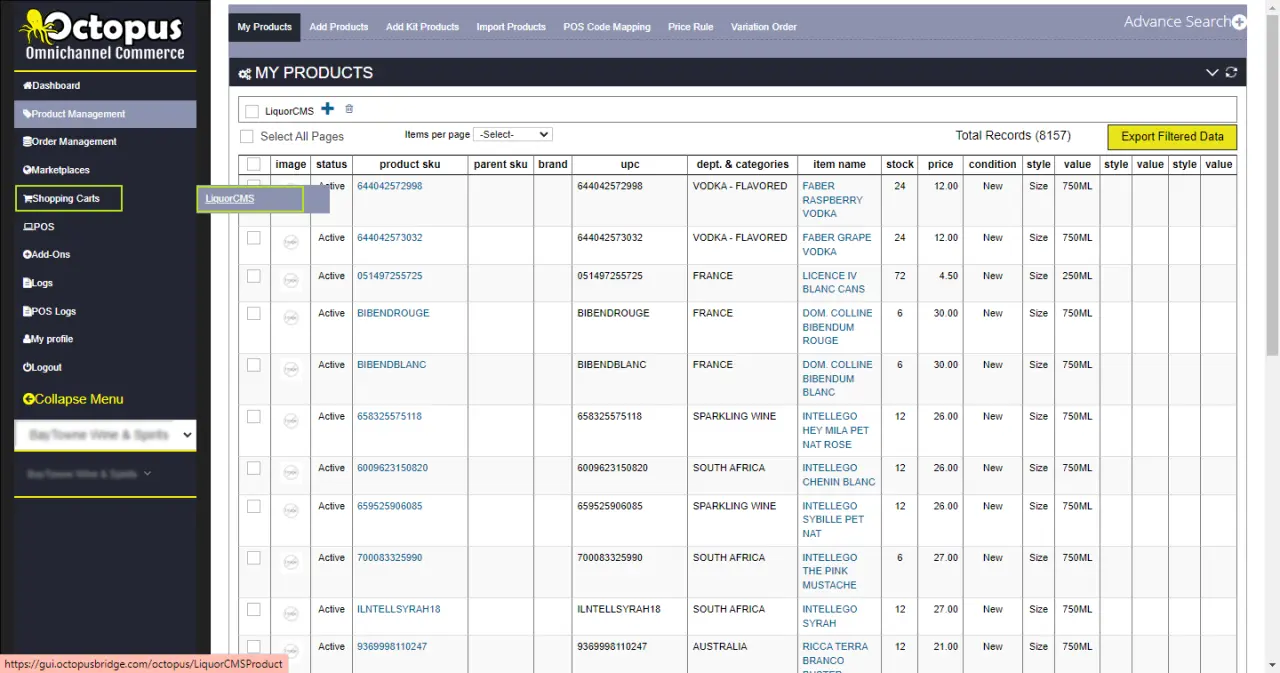
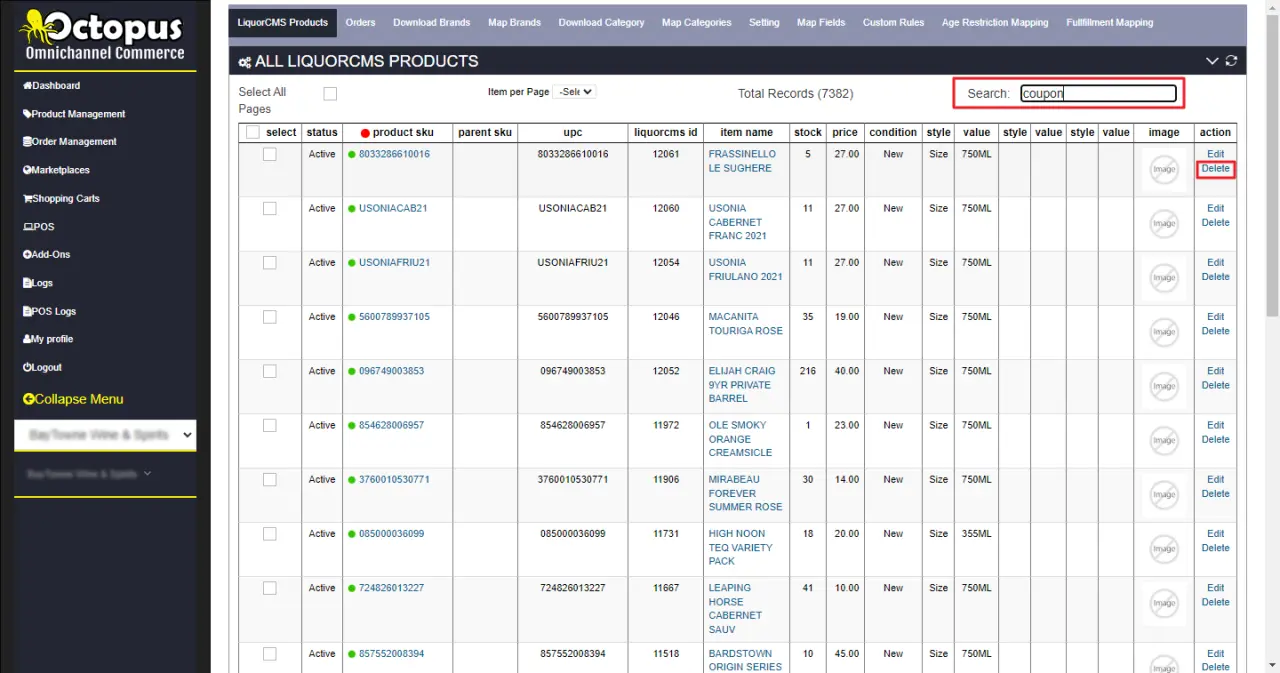
The current CMS Max Octopus Bridge guide shows the CMS Max shopping-cart destination and a product-level delete control used to stop sending an item. Final steps and resulting CMS Max behavior depend on the active connector version and approved configuration.
Current source references
Products, editions, APIs, plans, connectors, field maps, and supported directions change. These references establish the current public support path; the merchant's written scope and acceptance evidence govern the implementation.
SmartVendor integration FAQ
Use these answers as discovery prompts, then convert them into a field map, acceptance tests, operator procedures, monitoring, support boundaries, and named owners.
Yes. 24Seven Commerce currently lists SmartVendor POS among the systems supported with CMS Max. The connection uses a separately configured Octopus Bridge environment, and compatibility for the merchant's exact version, account, locations, and workflows must be confirmed before launch.
No. The documented path uses Octopus Bridge as a separately configured middleware layer between SmartVendor POS and CMS Max. Credentials, connector hosting, product selection, field mappings, schedules, directions, logs, and support ownership are part of the implementation.
The public CMS Max guide verifies selected product publishing through Octopus Bridge and a product-level control used to stop sending an item. Product fields, variants, images, prices, inventory, locations, customers, orders, taxes, discounts, fulfillment, cancellations, refunds, and returns must each be documented and tested before they are treated as supported.
Confirm the active SmartVendor version, locations, price levels, product matrices, and the Octopus Bridge package assigned to the merchant.
Choose one accountable owner for every data domain. A common starting point is SmartVendor POS for stable product identity and operational inventory, with CMS Max owning web merchandising and customer-facing content, but the approved contract must reflect the merchant's real workflow and provider capabilities.
Begin with discovery and representative data, resolve identifiers and catalog structure, document every field direction and exception, configure a limited assortment, reconcile products, prices, and stock, test the complete online order lifecycle, pilot by category or location, then expand with monitoring, owners, support escalation, backups, and rollback steps.
Build connected retail
Bring the exact product and version, locations, representative catalog, data owners, fulfillment model, customer policy, current website, connector information, and growth goals. CMS Max will map the supported connection and launch plan.
The world's fastest and most SEO friendly website code.