Catalog control
Map PHP POS items, variations, item numbers, categories, tags, eCommerce eligibility, media, prices, locations, and archive behavior into a governed web catalog.


Retail POS and custom commerce
Build a serious online store around the item, inventory, customer, and retail workflows already running at the counter.
PHP Point of Sale documents products, variations, categories, tags, store inventory, customers, orders, and eCommerce synchronization patterns. CMS Max can implement a custom connection only after the merchant environment and supported data contract are verified.
Built around the business process
An integration earns trust when customers can complete the intended journey, operators understand the system boundaries, and failed records become visible work rather than silent data drift.
Map PHP POS items, variations, item numbers, categories, tags, eCommerce eligibility, media, prices, locations, and archive behavior into a governed web catalog.
Define which store or location supplies online inventory, how sales and returns change it, and what customers see when updates are delayed or a record fails.
Prove the approved customer and order handoff, then reconcile items, totals, tax, tender, fulfillment, cancellation, refund, and reporting.
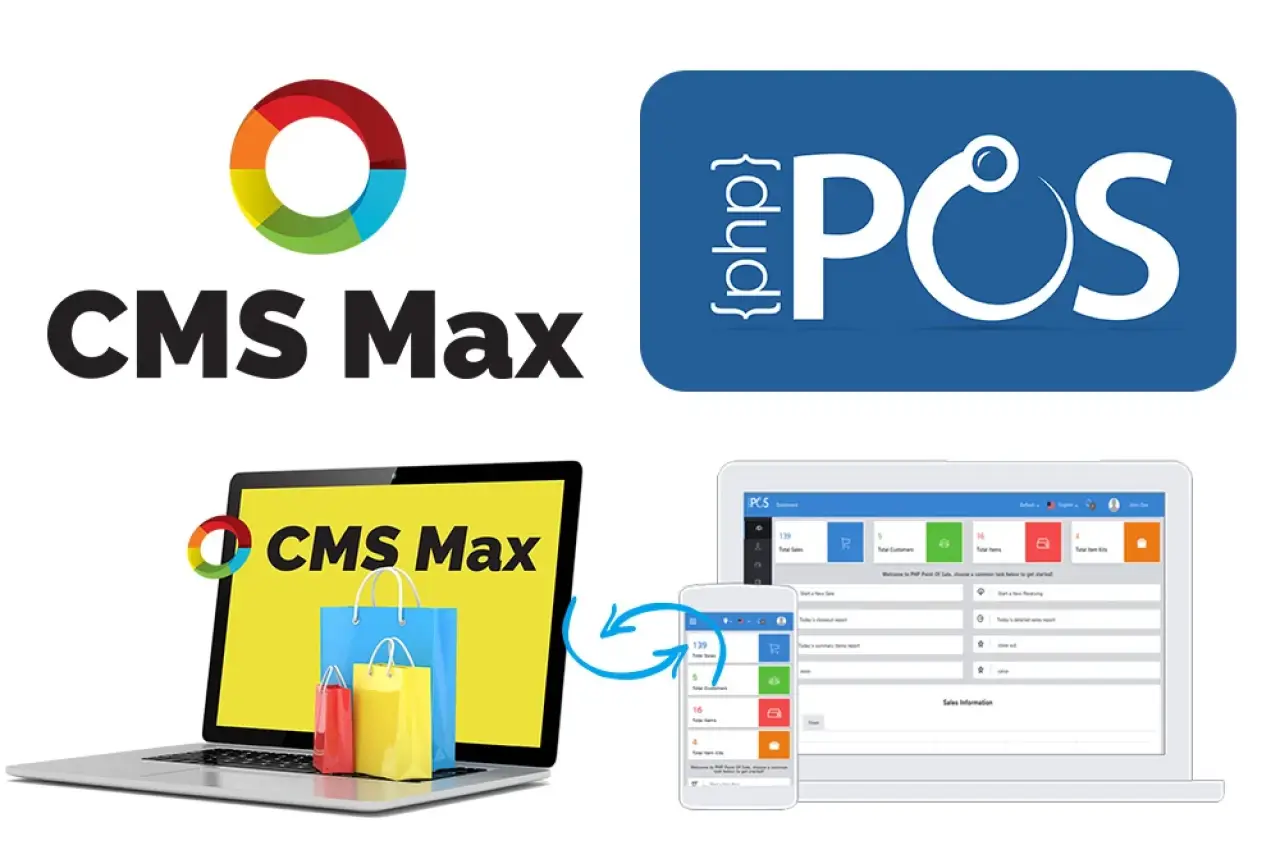
Support classification: The existing CMS Max page establishes a PHP Point of Sale integration offering and a direct-connection visual. No first-party CMS Max package exists in the reviewed application repository, so native, bidirectional, instant, and one-hour setup claims are not carried forward without implementation evidence.
Architecture before automation
The safest design moves only the data needed for a real business outcome. It assigns one owner per field, preserves provider behavior, exposes exceptions, and keeps customer promises understandable when a dependency is delayed.
Evaluate PHP Point of Sale as the operational owner for item and variation identity, categories, tags, prices, store inventory, customers, sales, and retail reporting supported by the merchant deployment.
Use the approved integration method for authentication, identifiers, data reads and writes, schedules or events, mappings, queues, logs, retries, rate limits, reconciliation, and provider support.
Use CMS Max for the custom storefront, web content, product enrichment, category architecture, search, SEO, checkout, fulfillment, forms, campaigns, feeds, and analytics.
Current provider evidence
Provider documentation establishes what the source platform can expose in some environments. It does not automatically establish merchant entitlement, CMS Max field support, data direction, update timing, or production acceptance.
| Surface | Current provider evidence | CMS Max decision |
|---|---|---|
| Items and variations | PHP Point of Sale documents items, item numbers, attributes, variations, serial numbers, categories, tags, prices, and eCommerce eligibility controls. | Confirm which fields are available through the approved CMS Max integration method and which remain web-only enrichment. |
| Inventory and locations | PHP POS documents store-location inventory and eCommerce synchronization settings. | Select the online inventory location or allocation rule, safety buffers, reservations, transfers, returns, and stale state. |
| eCommerce patterns | PHP POS documents Shopify and WooCommerce synchronization for products, categories, inventory, and orders. | Those provider-specific connectors demonstrate the POS data model but do not prove the CMS Max field map, direction, timing, or support. |
| Customers and reporting | PHP POS provides customer, sales, inventory, and report workflows for retail operations. | Define customer matching, consent, guest records, order import, tender representation, returns, historical data, and reporting acceptance. |
Customer and operator journey
Customers experience one brand even when several systems participate. The website, provider surface, staff workflow, confirmation, support, and recovery path need to agree about what happens next.
Confirm PHP POS edition and version, cloud or self-hosted deployment, locations, eCommerce settings, data model, credentials, and support.
Resolve item numbers, UPCs, duplicates, variations, categories, tags, prices, inventory, images, customers, orders, and historical records.
Test each approved direction, schedule, event, failure, retry, deletion, return, refund, and reconciliation rule with a limited assortment.
Pilot by category or location, monitor closely, reconcile daily, preserve rollback, train operators, and expand after acceptance criteria hold.
CMS Max growth layer
The source platform manages its operational domain. CMS Max adds the customer-facing content, discovery, conversion, campaign, form, feed, measurement, and publishing systems that help the business compete online.
Build the design, navigation, product or service discovery, location paths, content hierarchy, accessibility, performance, and responsive behavior around the brand and audience.
Add useful descriptions, specifications, comparisons, FAQs, policies, guides, media, campaigns, location content, and customer education beyond operational source fields.
Create intentional URLs, category and location structure, metadata, internal links, canonicals, structured content, redirects, sitemaps, and ongoing SEO workflows.
Connect checkout, quotes, appointments, catering, forms, pickup, delivery, shipping, loyalty, support, and other approved next actions without dead ends.
Use governed content and product data in search, advertising, email, forms, landing pages, analytics, attribution, remarketing, and conversion improvement.
Give teams logs, alerts, reconciliation, retry and replay procedures, change control, manual overrides, provider escalation, backups, and a controlled pause path.
Field-level acceptance
The implementation contract names the source, target, identifiers, transformation, timing, exception behavior, test evidence, reconciliation rule, and owner for each data domain.
| Data domain | Direction to evaluate | Required acceptance evidence |
|---|---|---|
| Items and variations | PHP POS to CMS Max | Item ID, UPC or EAN, SKU, parent, options, serial behavior, category, tag, image, eCommerce flag, and archive reconcile. |
| Price and tax | Define one owner per field | Cost exclusion, base and online price, tiers, sale, tax, discount, currency, rounding, and schedule pass. |
| Inventory | PHP POS to CMS Max | Store or location, quantity, reservations, safety buffer, counter sales, online sales, returns, transfers, and latency reconcile. |
| Customers | Define match or exclusion policy | Email, phone, customer ID, duplicate prevention, guest checkout, consent, history, notes, and privacy requests are governed. |
| Online orders | CMS Max to PHP POS if approved | Items, variations, customer, totals, tax, payment representation, shipping or pickup, status, retry, and idempotency pass. |
| Returns and reports | Define operational source | Cancellation, partial and full refund, return, stock restoration, tender, daily totals, and exception queue reconcile. |
Controlled implementation
A strong launch protects the source operation, customer promises, search visibility, data ownership, security, support, and the team's ability to recover when a dependency or record fails.
Confirm the exact product, account, edition, region, environments, locations, access, owners, support agreements, current website, data volumes, operating constraints, and peak periods.
Resolve identifiers, duplicates, products or services, variants, categories, prices, inventory, customers, orders, locations, consent, statuses, deletions, and exceptions.
Build in non-production where possible, test every approved direction and failure state, measure latency and throughput, reconcile values, and document operator procedures.
Launch a limited scope, monitor closely, reconcile daily, preserve rollback, train owners, fix exceptions, and expand only after acceptance criteria hold.
Highest-risk boundary: PHP Point of Sale publishes detailed Shopify and WooCommerce connector behavior, but that behavior cannot be copied onto CMS Max by assumption. The CMS Max connection needs its own technical contract, implementation evidence, performance measurements, and provider support path.
Operational ownership
The provider, integration, website, and merchant operation are separate responsibilities. Explicit boundaries make incidents faster to diagnose and customer promises easier to defend.
Visual and source evidence
Products, editions, APIs, plans, connectors, fields, directions, and limits change. Review the provider sources, then let the merchant's signed scope and acceptance evidence govern the live integration.
PHP Point of Sale integration FAQ
Use these answers as discovery prompts, then convert them into architecture, a field map, acceptance tests, operator procedures, monitoring, reconciliation, support boundaries, and named owners.
CMS Max has an established PHP Point of Sale integration offering. Because the reviewed application repository does not contain a first-party PHP POS package, the exact connection is treated as a custom implementation and must be verified against the merchant deployment, access method, fields, directions, timing, and support.
The prior page used those terms without repository evidence. The rebuilt page does not. Products, variations, prices, inventory, customers, orders, cancellations, refunds, and returns are each considered separate directions and become supported only when they are documented and pass acceptance tests.
PHP POS documents location-based inventory and eCommerce synchronization patterns. The CMS Max project must confirm the approved access method, online location or allocation rule, quantities, reservations, buffers, update timing, retries, returns, and stale storefront behavior.
That is a discovery and acceptance item. The project must verify the destination, customer matching, items and variations, totals, tax, payment representation, shipping or pickup, status, retry, duplicate prevention, cancellation, refund, and reporting behavior.
There is no universal one-hour promise. Duration depends on product and variation counts, images, locations, API or connector limits, data quality, duplicates, transformations, network performance, retries, and review requirements. A representative sample is measured before scheduling the full run.
Bring the PHP POS edition and version, deployment type, locations, item and variation samples, eCommerce settings, credentials or integration documentation, price and inventory rules, customers, orders, returns, current website, support contacts, and migration goals.
Build connected operations
Bring the exact product and account, environments, locations, access, representative records, data owners, customer journey, current website, support contacts, operating constraints, and growth goals. CMS Max will map the supported path and launch plan.
The world's fastest and most SEO friendly website code.